
Denim Day Insights: The Importance of Coordinated Care for Survivors
Rose Andom Center Committed to Removing Barriers to Coordinated Care
 Whitney Woods (she/her) is the executive director of the Rose Andom Center, Colorado’s first and largest family justice center, a survivor-centered, trauma-informed collaborative that provides resources for individuals and families impacted by domestic violence and sexual assault. She leads the Center’s strategic direction, ensuring survivors have access to safety, healing, and justice. Woods has nearly 20 years of leadership experience spanning nonprofit, corporate, and government sectors.
After a Sexual Assault, She Was Left With the Question, “What Happens Next?”
She knew something had happened—something wrong—but the night was fractured, pieces of it missing in ways she couldn’t explain. What remained was a deep, unsettling certainty: she hadn’t been safe.
At urgent care, she searched for answers, for someone to tell her what to do. Instead, she was met with a quiet dismissal: “We don’t do that here. You’ll have to go somewhere else.” No direction, no guidance—just a door and the long walk back to her car—alone, shaken, and unsure where to turn next.
So she went home. She sat with the fear, the confusion, the questions that only seemed to multiply as the hours passed.
Later that evening, she went to the emergency department. There, she told her story—what little she could piece together—again and again, each retelling an effort to make sense of something that refused to fully come into focus. She underwent a Sexual Assault Nurse Examiner (SANE) exam, a process that offered moments of clarity, of care, of being believed.
But when it was over, and the room grew quiet again, she was left with the question that so many survivors carry:
What happens next?
When Services Are Disconnected, The Burden Shifts to Survivors
She was told she would need to file a police report separately, during normal business hours. There was no immediate pathway connecting medical care to reporting, legal support, or advocacy. Instead, she was left to navigate multiple systems on her own, at a time when support should have been most accessible.
Her experience is not unique. Stories of navigating this tangled system is something we hear every day at the Rose Andom Center (RAC). It reflects a broader gap in how communities respond to sexual violence.
April is Sexual Assault Awareness Month and April 29 is Denim Day. They offer an opportunity to examine not only the prevalence of sexual violence in our communities, but the systems designed to respond to it.
At the Rose Andom Center, we see how access to services alone is not enough. Survivors need systems that are coordinated, equitable, and responsive to the realities of trauma. RAC was built to address fragmentation. By co-locating law enforcement, prosecutors, advocates, and community partners, RAC reduces the burden on survivors who would otherwise have to navigate these systems independently.
When services are disconnected, that burden shifts to survivors—often at the expense of their safety, well-being, time, and ability to heal.
Rose Andom Center Now Offers A Coordinated Care Model to Sexual Assault Survivors
In April 2025, we expanded our services to more intentionally support sexual assault survivors. One year later, as we evaluate that expansion, we see incredible progress, but also persistent gaps, particularly in how medical care connects to the next steps.
Access to SANE exams remains inconsistent across the broader Denver metro area, and even when survivors receive care, that care is often not integrated with reporting, legal services, or advocacy. Each additional step requires survivors to reengage, retell their story, and navigate systems that were not designed to work together.
This is not just a service gap. It is an equity issue.
Survivors who face language barriers, immigration concerns, economic instability, or systemic mistrust are disproportionately impacted by fragmented systems. When services are not coordinated, these inequities are compounded, limiting access to justice and support.
At the same time, the organizations working to fill these gaps are facing increasing instability. Federal programs such as the Victims of Crime Act (VOCA) and the Violence Against Women Act (VAWA) were established to fund critical services, including advocacy, counseling, and medical care. Recent reductions in funding and delays in federal grant cycles have created immense uncertainty, making it more difficult to sustain and expand coordinated, survivor-centered models.
Despite these challenges, we see a clear path forward.
Building Toward Seamless Care: Our Goal to Offer SANE Exams On-Site
The Rose Andom Center is proud to have an on-site Denver Health clinic, ensuring clients can access medical care in a familiar, supportive environment. By expanding these services to include SANE exams, we have a powerful opportunity to create a more seamless, integrated response.
Within our already coordinated model, a survivor could receive a SANE exam, connect with an advocate, file a police report with a Denver Police Department Sex Crimes Unit detective, access legal support, and complete a Crime Victim Compensation application—all in one trauma-informed space, with continuity of care at every step.
This approach is not only more effective—it is more equitable. From its foundation, the Rose Andom Center is committed to reducing barriers, minimizing retraumatization, and centering survivor choice. Now is the time to stand with this vision and support the expansion of services that move us closer to a truly coordinated, survivor-centered response—one where every person who seeks help is met with care that is seamless, supportive, and grounded in equity.
Because survivors should not have to navigate complexity to access care—they should be met with systems intentionally designed to support them—fully and without unnecessary barriers.
That is how meaningful change takes root—and how we build a response that truly meets survivors where they are.
On Denim Day, Advocate for Policies and Funding that Prioritize Survivor-Centered Systems
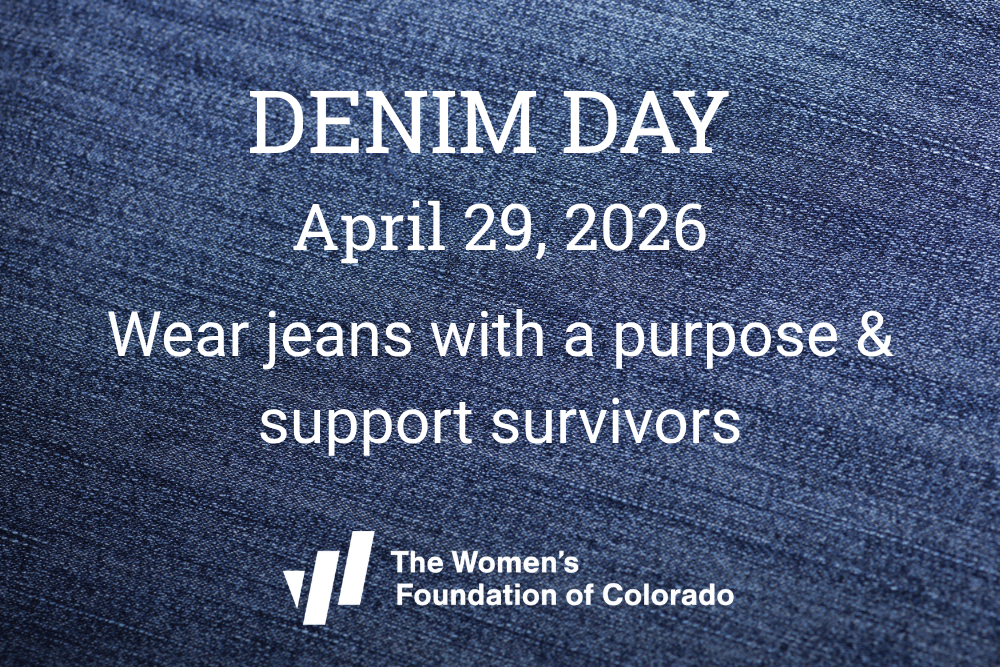
Denim Day is April 29, 2026. Join millions of people across the world that will wear jeans with a purpose, support survivors, and educate themselves and others about all forms of sexual violence.
There are many ways to take action during Sexual Assault Awareness Month and on Denim Day: Start by believing survivors, and:
- Support organizations, such as Rose Andom Center, advancing coordinated care.
- Advocate for policies and funding that prioritize survivor-centered systems.
- Attend events that shift the conversation from awareness to action, such as the Denim Day party for the Colorado Coalition Against Sexual Assault or Rose Andom Center’s 10-year anniversary gala on Oct. 17, 2026. The Women’s Foundation of Colorado is proudly sponsoring both.
The Women’s Foundation of Colorado is a nonpartisan organization. The opinions of guest bloggers are their own and do not necessarily reflect the opinions or positions of The Foundation.