
Colorado Women Can’t Get Ahead As Costs Outpace Incomes
Running to Stand Still: Colorado Women Can’t Get Ahead As Costs Outpace Incomes
Ahead of June 30 Primary Election, New Poll Indicates Women Want Lawmakers to Address Finances, Health, and Safety
DENVER – May 28, 2026 – A new poll commissioned by The Women’s Foundation of Colorado finds that the majority of Colorado women are struggling to move forward because of insufficient incomes and the soaring cost of living, concerns about personal safety, and health care challenges. The Women’s Foundation conducted a statewide survey of women and gender-expansive individuals to identify top issues impacting their wellbeing ahead of the primary elections on June 30 and a live gubernatorial forum on June 7.
“A vast majority of Colorado women say they have fewer rights and opportunities than men, and nearly half say the gap has worsened in the last decade. Women are falling behind financially and in their personal freedoms,” said Renee Ferrufino, The Women’s Foundation of Colorado president and CEO. “When women thrive, families stabilize, communities strengthen and our entire state’s economy grows. We must elect people who value women, their experiences, and prioritize what they need to flourish.”
The poll found that the only area in which women say they fare better than men is in social connections and emotional support. Otherwise, women say they fare worse on nearly every material measure, including money, jobs, caregiving burdens, health, and safety.
 Top Findings: Costs Outpace Incomes, Safety, and Healthcare Access
Soaring Cost of Living
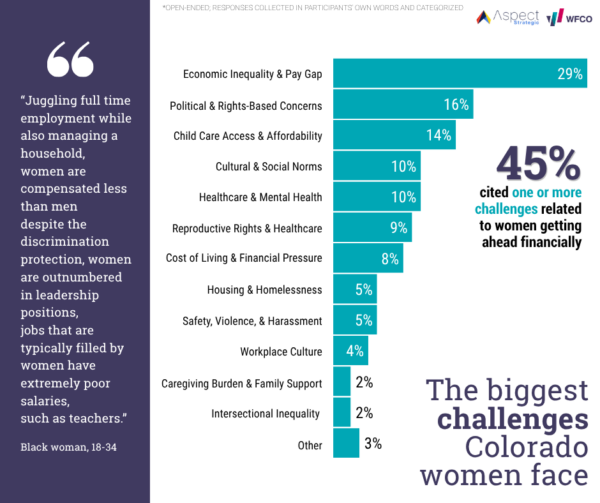
A resounding 84% of women said the cost of living is rising faster than their incomes. This rose for Black women (91%) and LGBTQ+ women (93%). While a third of women (33%) said affordable access to high-quality health care would help them get ahead, a greater portion of Hispanic women (43%) felt this way.
Insufficient Income
Women aren’t paid enough and experience barriers to career growth. Respondents said women are worse off than men with regard to unpaid work and caregiving (69%) and access to jobs that offer living wages and opportunities to advance (58%). Namely, Asian American Pacific Islander women (77%) identify unpaid work and caregiving as barriers while Black women (69%) say living wages and advancement opportunities are out of reach.
 Safety Concerns
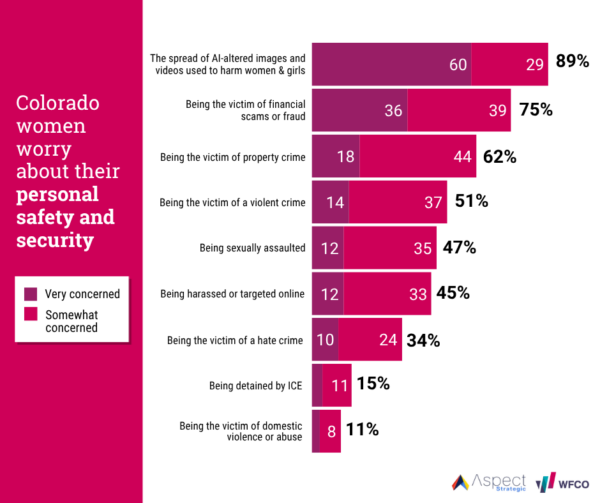
Economic insecurity and safety are woven together – three-quarters of women (75%) are worried about being financially preyed upon by fraud and scams, even more than violent crime (51%) and sexual assault (47%). However, concerns varied by age: Young women, aged 18-34, are more concerned about sexual assault (59%), while older women, 65+, are more concerned about scams or financial fraud (82%). While a smaller percentage of all women (11%) are concerned about being the victim of domestic violence or abuse, this concern was higher for rural women (17%).
Health Care Access
In terms of health care, in the past 12 months, one in three women (34%) say they’ve felt unheard or misunderstood by a provider and a quarter (27%) avoid care because they fear not being taken seriously. Two in five of all women (42%) and more than half (58%) of LGBTQ+ respondents have turned to social media or AI for health information instead of a doctor.
Day-to-Day Impacts
Respondents identified how their incomes, cost of living, and safety challenges affect their quality of life:
- Nearly 3 in 5 (58%) said an unexpected $500 bill – like a flat tire or a co-pay – would worry them about their ability to cover basic expenses the next month. An overwhelming number of low-income women (88%) would be concerned.
- Three in four made at least one hard financial choice in the past year, like cutting retirement savings (47%), using “buy now, pay later” for basic expenses (46%), and skipping or delaying medical care (41%) due to financial reasons.
- Close to half (44%) of respondents reported being trapped because of financial constraints, postponing or cancelling major decisions such as changing jobs, career education, moving, buying a home, having children, retiring, or leaving an unhealthy relationship
Some women added comments, explaining their struggles:
- “I’ve had to cut out dental and health care for my entire family.”
- “Saving for retirement is all the way out the door, and trying to buy a house seems more and more out of reach.”
- “Being a 74-year-old woman, I would like to work less but due to the economy I haven’t been able to reduce job hours. Instead, I’m working more to be able to pay all the bills and buy food.”
- “I delayed leaving a bad partnership due to a binding housing lease. I ended up leaving the situation and moving in with family while still paying rent on the place he lived at.”
Demand for Action
Most women (72%) say state leaders should do more to help women thrive and are more likely to support a candidate who makes it a top priority (63%). Respondents selected one to two issues that would help them thrive and the top answer was cost of living and affordability (28%). Additionally, more than half of women (52%) would be interested in starting or growing their businesses if they had access to resources, money, and support. Nearly two-thirds (64%) of Black women would be interested.
Hear From the Candidates
 The Women’s Foundation of Colorado, Rocky Mountain PBS, and the Colorado Women’s Chamber of Commerce will host Women Decide: The Colorado Governor’s Forum, a virtual nonpartisan gubernatorial primary forum on Sunday, June 7, at 7:00 pm MDT. Poll findings will inform candidate questions on issues like equal pay, workers rights, entrepreneurship support, affordable housing, accessible child care, health care that’s responsive to women’s needs, and retirement solutions.
“Women told us exactly what they need to thrive and they want concrete action from the next governor of Colorado to help them get ahead,” said Ferrufino. “The Women Decide forum will give Colorado candidates for governor the opportunity to explain how they will ensure women can build fulfilling lives for themselves, their families, and their communities.”
The poll surveyed 725 Colorado voters who identify as women between April 27 and May 4, 2026, conducted by Aspect Strategic. It includes oversamples of Hispanic, Black, and AAPI respondents and other women of color which allows for meaningful subgroup analysis.
The Women’s Foundation of Colorado is a statewide community-funded foundation protecting women’s progress and creating more pathways to gender, racial and economic equity. The poll was made possible with funding from the M & I Charitable Giving Fund and supported by other generous donors.